Exhibition of Chinese money
Jul 18, 14:42 Filed under culture
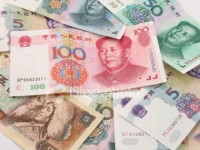 You have now a great chance to see a traveling exhibition called Money of China. This exhibition was put together by the National Library of the Czech Republic and the Embassy of the People’s Republic of China in the Czech Republic. And it truly is interesting.
China has a long and fascinating history. For many people in Europe, China is a huge distant country with a communistic regime and population that is fairly big. Most recently, China has become the country with cheap labor force driving all European producers mad.
Anyway, this exhibition is about the history of money in China from the very beginning up to the present day. And it is to say that China is one of the world’s oldest civilizations so you will see some progress – from the shells, through money in shape of knives – neat idea, isn’t it? – through the coin money and paper money as we know them today.
In the exhibition there are English posters with brief history of every period. You will read about the problems with establishment of paper money, you will read about the unique status of Hong Kong, about the reforms that changed the planned economy into the market economy – yes it is really there! – and of course about the new versions of Renminbi, the official currency in China with its Yuan.
The exhibition is in the Klementinum Gallery, 1st floor. Klementinum itself is worth visiting so you can make two exhibitions at one time. ? It runs till August 26. Klementinum is in street Krizovnicka 190. Best accessible from the Charles Bridge.
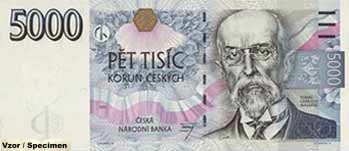 On this banknote could be no one else but Tomas Garrigue Masaryk – the chief founder and first president of independent Czechoslovakia.
 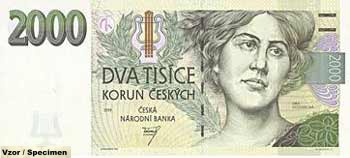 Czechs have always loved music. How else could you explain so many famous composers like Smetana, Dvorak, Janacek from a country this big? And when we talk about Czech music we can’t leave out Emma Destinova, or Emmy Destinn (1878-1930), who was one of the greatest opera singers of all time – and yes, that is the lady on the 2 000 CZK banknote.
 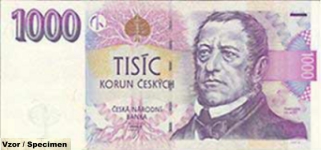 On this banknote there is Frantisek Palacky who was a significant Czech historian and a politician. He was born in 1798 and died in 1876 which was, thanks to Palacky himself, a time period of the Czech National Revival – a movement which aimed to revive the Czech language, culture and history.
 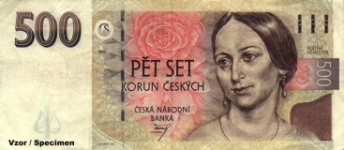 On the 500 CZK banknote there is painted Czech authoress Bozena Nemcova. Her best known and widely read book is named Babicka, in English Grandmother, published in 1855. It is a book about her childhood and her happy memories of her kind and wise grandmother, describing country life in the Czech lands in the 19th century. Czech kids read this book in schools even today.
 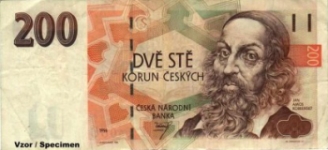 On the 200 CZK banknote there is Jan Amos Komensky, in English John Amos Comenius (1592-1670). Comenius was a Czech teacher, scientist, educator, writer and a protestant bishop. Because of his religion he was forced to leave Bohemia and therefore lived and worked in many different countries in Europe, and thus Comenius became known as the „Teacher of Nations“. He has been stamped the „Father of Modern Education“ since he came up with new ideas concerning teaching methods that we still use today.
 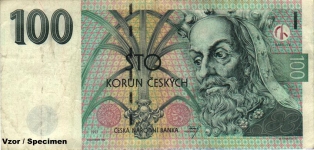 On the 100 CZK banknote there is Charles IV (1316-1378), Holy Roman Emperor and King of Bohemia who is regarded by Czechs as „Father of the Country“. Prague as it looks now owes a lot to him.
 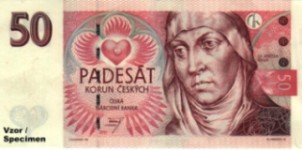 Starting with the banknote 50 CZK. Although a 50 coin is now taking over, the banknote is still widely available. There is portrayed St. Anezka Ceska, in English Agnes of Bohemia, who lived from 1211 to 1282. She is the patron saint of Bohemia and
 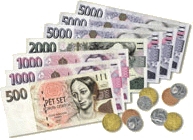 Let’s talk about money – it is always a juicy topic. But don’t worry I am not going to sing the famous song. I want to talk about the Czech currency – the Czech crown (koruna in Czech), abbreviated as Kč, internationally CZK.