Flames Lighting the Prague Night Sky

5 days ago Filed under news

Two major fires scared and excited the Prague public during the recent days. Luckily, none of them claimed any casualties. The first claimed a major historical building and the second may have an unwelcome impact on the attitude off the majority towards the Vietnamese minority in Czech Republic.

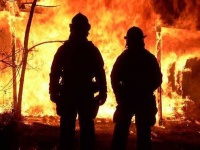
On 16th of October, the Industrial Palace at the Prague Exhibition Ground (Výstaviště) almost burned down. One of the reasons of its partial collapse was its construction: the steel skeleton of the building probably cracked after it was heated by the flames and then abruptly cooled down by water from fire extinguishing machines.

It’s not the whole building, only its left wing, but the loss is enormous. It will be a conflicting question whether the previous form should be copied, or a completely new architecture developed out of the rubble.

The Exhibition Ground was built to host an exhibition of great importance, the 1891 celebration of the 1781 exhibition that took place in Klementinum. The preparations took three years and it seemed the whole business will have to be postponed, as Prague was damaged by major floods in 1890. The organizers managed to keep with the timetable. The palace was opened at the same day as the exhibition: on March 15, 1891. Technically speaking, it did not, and does not lie in Holešovice, but in Bubeneč, on the area taken out of the Stromovka park. The palace was the first major building with steel construction in the area of today’s Czech Republic. The design carried modern features, but generally it was built in historicist style, not the then- dominant art noveau.
During the five months it was open, the exhibition was visited by approx. 2,5 million people. Many large exhibitions and international fairs took place at the site since then. In 1948 its status was changed, the Industrial Palace was renamed as Congressional and it hosted the Czech Communist Party conventions. It remained so until 1991, when a jubilee exhibition marking its hundred years of existence was opened. Unfortunately it was not very successful.

Then, on November 6, a large Vietnamese marketplace was up in flames. It took fifty- three firefighter units (more than 400 firefighters) sixteen hours to defeat the fire. There was a huge cloud of waste, people living nearby were told to stay at home, traffic was complicated.

It took place in Libuš, in the commercial area called Sapa, or Little Hanoi. The fire was not that terribly large, the main problem was that the marketplace/storage was stuffed with various goods. The firefighters didn’t know what was inside, whether there won’t be an explosion, or when the roof would collapse. For safety reasons, they decided to extinguish the fire from the outside.
It’s possible that safety standards inside the building were not met. Little Hanoi is said to have been quite isolated and the suspicion is there. Also, the fire bothered many people nearby, the operation cost millions and it was potentially dangerous to other objects. These points are likely to add to the reserved attitude of Czechs towards the Vietnamese minority in CR. The relationship is not actually bad, Czechs often admire the Vietnamese shopkeepers’ determination and ability, after all, they’re working hard, but the Czech attitude is still quite patronizing and often suspicious. There is a stereotype of every Vietnamese being an uneducated shopkeeper and of their goods being faulty and often fraudulent. Any case like this one may add to the suspicions and latent xenophobia that may sometimes be seen in the Czech public. While stereotype- breaking examples are scarce and little accented by the media, images of a Vietnamese market covering its neighborhood in smoke, is not welcome.
So far it seems both cases were accidental, although the second is yet to be investigated.

Comment

Ground Collapsing for Blanka

5 days ago Filed under news

Stromovka is a 740 years old park, originally a hunting game-park for Czech monarchs. It’s a large area with various plants (trees mainly), several buildings and ponds. The latter were, and still are, watered by the famous Rudolph’s tunnel. The park has been opened for the public since1804 and during the century many new trees, including kinds from abroad, were planted. Until 1891 that is, as the construction of Výstaviště Prague Exhibition Ground began and a substantial part of Stromovka was swallowed by the new project.

It survived various misfortunes, echoes of war or natural disasters. The last blow was the damage done by the 2002 floods.
It’s still large and beautiful enough to attract Prague residents. Especially in the middle of a big, polluted city, it’s quite a valuable place.

Now there’s a bit of a nuisance. A tunnel, Blanka, is being dug under the park. Blanka is part of the famous Prague by-pass highway, an enormously expensive project that is said to take up to seven years from now to be completed. While there is probably no better choice than to build it, in case of Stromovka and Letná, the pill becomes pretty hard to swallow.

In June, a 10- m diameter hole appeared on a peaceful Stromovka meadow. The soil collapsed because of the digging that was taking place below. Luckily, no one was strolling or resting in the grass on that exact spot, the person would have quite possibly been buried alive.

Anyway, accidents happen, this was not a tragic one, so let’s just hope it won’t happen again. Well, it did happen again. In October, a 30 m diameter crater developed on the park green. Again, nobody was hurt, and it didn’t happen instantly, it was rather a process. But it caused quite a sensation- Now, for the rest of the digging, the whole endangered area on the surface is to be encircled by a fence, so the security problem seems to be solved.
The question is at what price. The price is that the park will lose its function for a time. A large part will be sealed off by an opaque fence, which could give the park a touch of a construction yard atmosphere. That doesn’t seem very desirable.

Better not to get hysterical, it’s more of a minor problem, currently entertaining the Prague media. But it reminds us, yet again, how difficult it is for a big city to solve major rise in traffic. Letná is now a construction site altogether, in relation to the same Blanka digging. It’s nice to get the main line of traffic underground, though it’s not really much more ecological: the emissions don’t get absorbed by soil, the waste will have to get to the surface through ventilation. At least it reduces the noise levels. But the future of the Letná park is as uncertain as ever and its current – though temporary – state is depressing.

It will also need at least one more bridge across Vltava, one that would serve exclusively the transit traffic. The criticism of the project is heard and it probably will be for some time. I wonder what the evaluation will be in the end, right now it’s quite a test of patience.

Comment

Beings from nowhere

8 days ago Filed under prague-events

There is an interesting exhibition you can visit in City Gallery Prague, which is situated in the 4th floor of the main building of the Prague Municipal Library, Marianske Square nr. 1, not far from the Old town Square.

The exhibition is called Bytosti odnikud, in English Beings from nowhere, with a subtitle Metamorphoses of Academic Principles in paintings of the first half of the twentieth century. The title of the exhibition quite appropriately says what it is about. It presents works which were made with aims to present human body, somehow following academic principles of its depictions, set centuries ago. Although those principles were seriously “overcomed“ by avant-garde movements in late 19th and first half of 20th century, there obviously still were authors, who followed old academic principles of realistic depiction of human body, and especially popular depictions of female naked body. But their works were in history of Art put behind those done by progressive avant-garde authors. This quite extensive exhibition now “puts them on light“. If you like realistic painting, and especially painting of female nudes, which are there plenty, you should like some of the works exhibited here. But you also visit it if you are interested in Art history and want to discover some of its less known chapters.

Entrance fee to the gallery is 120 Czk or 60 Czk reduced price for students, children and retirees. Opening hours are from 10 am to 6 pm every day except Mondays. And the exhibition is to be opened until 1st of February 2009.

Comment

Kundera Accused of Getting a Spy to Jail

14 days ago Filed under news

There is a lot of talk about Milan Kundera these days. Not that his books would suddenly become so very popular. He´s in the news, supposedly disclosed as a snitch. In 1950 he assisted the Secret police in arresting Miroslav Dvořáček, a returned émigré, a CIC operative at the time. The man Kundera supposedly informed on spent next 14 years in jail.

No matter how tragic the case is, it’s not as simple as it may seem. Kundera did not give in a “politically unreliable” schoolmate or someone making anti- Communist leaflets, the motive was not political affiliation. The man whom he informed on was a spy, he was decidedly working against the state that Kundera, as a Communist, was at the time loyal to. Today we view Dvořáček as a freedom fighter, a man of courage, who sacrificed his safety for what he believed in. But in 1950 Kundera was one of hundreds of thousands, who saw him as an enemy, because he believed in the system. CIC, or Counter Intelligence Corps, was a US Army intelligence agency. In the eyes of those who believed in Communism, a CIC operative was something similar to a Russian FSB agent today. Most people would inform authorities, had they found out they have a foreign power’s secret agent next door.

Yes, there is a major difference: the then system was unlawful. But it was declared unlawful more than forty years later. And it proved unlawful clearly enough when the executions took place and when the Soviet forces were allowed to stay. At the time this case took place it was not as clear. Kundera rejected the system only several years later. His fault was that he did not foresee the unlawfulness of the regime before it started the executions, before the death of Stalin, before the invasion. Yes, it probably was a failure, but he always admitted it. Also, we have no problem with people who were loyal to the regime in the 1980s, when nearly all knew the system was sick right from the start- they are among our political elite. What does the new information, provided by the relatively new The Institute for the Study of Totalitarian Regimes, really say? No matter how I look at it, it basically says that Kundera was red as a cherry in 1950. Everyone knew that. Now we just have it on paper.

However, I agree that if the facts are right, Kundera probably should have revealed his deed. It is difficult to accept that he did not specifically address the case, he never apologized for it, he obviously didn’t contact Dvořáček or his family. I agree that’s not admirable, if he really id what he was accused of.

The truth is he did reflect his red years in his art, more than many other artists with a skeleton in the closet. He regretted his past and separated himself from politics for decades.

Anyway, opinions differ at this point. Some people will label Kundera as a traitor, a man not worthy of respect. It’s their opinion. What I see as the main truble here is the way it was presented. It was released by an Institute for the Study of Totalitarian Regimes employee and with the institute’s support. But it’s more of a journalist scoop than work of a historian.
The institute has quite a pompous name, considering what it managed so far. Not only oes it pay no attention to theory of totalitarianism and „studies“ only the Czechoslovak case (though the name implies general scope), it seems to concentrate on merely picking up docments from the Secret Police archives. It has, maybe unknowingly, already served political purposes during the last presidential election. Now is it going to contribute to our understanding of the past by releasing single documents proving that a celebrity’s name is in some police file? That’s not much of a contribution.

The Academy of Sciences of the Czech Republic has recently criticized the institute for the manner in which it approached the information. It was published as a magazine article, with little verification and no reaction from Kundera himself. He denies any wrongdoing and seems to be determined to go to court.

Comment

Regional Elections in Orange

15 days ago Filed under news

„An orange Tsunami” has swept through the Czech lands, the centre- left/”socialist” Social Democrats (CSSD) scoring a sweeping victory over the governing Civic Democrats (ODS). Voters were selecting their regional administration and a third of the Senate. Both grounds were traditionally favourable to the Civic Democrats, but this time, with the exception of Prague, they were overwhelmingly beaten. Also, local elections often help smaller parties, but this time it was almost completely a two- party contest. Even the two smaller parties from the governmental coalition had depressing results.
Jiří Paroubek suffered a heavy blow recently as one of his friends (or, at least, acquaintances) shot dead another. The killing took place on Paroubek’s party, when he was already gone. It is reported that the incident was preceded by a betting game: our socialist leader´s buddies were competing about the amount of money (meaning tens to hundreds of thousands CZK) they have in their purses at the moment. Anyway, the fact that the top left- wing politician throws ultra- posh parties with guys who go to a pub with a loaded gun behind the belt, did not prevent his party from winning. The reasons are obvious: The Civic Democrats are related to massive losses of money during the 1990s, the Communist Party are a league on their own (not meant as a compliment), the Greens are lost in space and the Christian Democrats have confused and incompetent elites. That is how many people see it.

The right- wing ODS paid not only for some unpopular reforms, or adjustments, but also for weak communication, inter-party and inter-governmental disputes and, in many cases, suspicious policies. And, chiefly, for their opponent´s ability to shift the emphasis from local issues to the issues concerning the whole republic. The election is more about technical, smaller- scale and ideology- free decisions, but the CSSD managed to persuade the voters that this is a referendum on the current government.

So, the current government, and mainly its leader have reasons to be nervous. It now seems almost certain that Topolánek will soon cease being the party chairman.
Anyway let´s, at least, have a quick look at the new Prague senators. The only three right-wing oriented senators who succeeded in this election were elected in Prague.

Zdeněk Schwarz is probably the best known of the three. He is the leader of Prague ambulance service since 1998. He was an independent candidate on the ODS list and so far it seems he won’t support everything the party stands for. He does not favour, for example, privatization of hospitals, which is something the current Minister of Healthcare is getting quite close to. Tomáš Kladívko was already an MP. He decided to focus on several recently discussed themes: for example a smoking ban in all restaurants (he’s against), the US radar base (he supports it) and the new National Library by Jan Kaplický (yes, but not on Letná). Miroslav Škaloud is a newcomer in top- level politics, one of many local politicians, who, after gaining a secure position, goes higher. That’s a must for any party, to have new elites coming from the lower levels of politics and it is something that the Social Democrats will have to face as their new regional leaders will, in time, challenge the centre.

Comment

Fire at Vystaviste - Prague exhibition ground

15 days ago Filed under dark-side-of-prague

On Thursday 16th of October, a catastrophe happened in Prague. There was a big fire in a precious historical building of Industrial Palace (Prumyslovy palac) in Vystaviste area in Prague 7. The fire completely destroyed the left (west) wing of the palace.

The fire was the most probably caused by an explosion at one of the stalls which were at the building because there was held dentist fair trade called Pragodent. But how and why explosion happened is quite unclear. Was it just an accident? There were also some speculations, that the fire was somehow connected with the Kockas family, who hires offices in Vystaviste and organizes here “Matejska pout”, popular event with various attractions. Vaclav Kocka, the younger, was shot a week before the fire, during the baptism of the book written by Jiri Paroubek, the leader of the political party CSSD. So are those just a speculations and the fire was only a very bad accident or there are really some connections with the events of the week before?

However it was, there is now hard work to be done, because the Palace should be renovated, and the burn wing should look exactly how it looked before, it is going to be difficult and expensive. But the palace is a heritage site of high importance.

The palace was built for the big exhibition in 1891 by the architect Bedrich Munzberger. For the same exhibition was also built such famous things as Petrin tower, Petrin funicular or Krizik’s fountain. The industrial palace was since then used mainly for exhibitions and fair trades. It was quite magnificent building, so lets hope that the renovation is going to be successful.

Comment

Chinese painting exhibition

16 days ago Filed under culture

Exhibition called simply Chinese Painting can be seen until 28th of November in Prague Rudolfinum Gallery. The exhibition, curated by Czech curator Petr Nedoma and his collegue from Hongkong, Chang Tshong-zung, presents three Chinese painters of middle generation, who today are probably the most famous, recognized and important painters of this country. They are Zhang Xiaogang, Fang Lijun and Feng Mengbo. Old European painting techniques of oil or tempera on canvases are quite new in China, so it is interesting to see, how those authors deal with this medium.

Zhang Xiaogang (1956) is mostly occupied with a topic of contemporary Chinese family in his work. His anxious big canvases are done mostly in shades of gray, with a specific use of red color for particular important parts of the pictures.

Fang Lijun (1963) is one of the leading representatives of something, which is called “cynical realism”. His big canvases are full of vibrant colors.

The most interesting painter of the three is Feng Mengbo (1966) who makes his work not only on canvases but also makes computer-generated video sequences, and an example of this part of his work is also shown in the exhibition. But he is interesting mainly for his huge and monumental canvases, either with flying birds and insect depicted on them or the newest series of landscapes, in a way continuing in a long tradition of Chinese landscape painting.

Chinese painting is still not that well-known here in the Czech Republic, so it may be interesting to see at least its most famous representatives, although it might have been better and more educative if there would be presented more authors on the exhibition, not just those three. But if you are into Art, you should not miss this exhibition. It is interesting to see how Chinese painting varies from the European or Americans ones, on which we are used to here.

Rudolfinum Gallery is situated in representative 19th century Rudolfinum building, situated on Jana Palacha Square, but the entrance to the gallery is from Alsovo Nabrezi Street, number 12. Opening hours are from 10 am to 6 pm daily, except Mondays.

Comment

Munich Agreement 1938 (Part Two)

27 days ago Filed under history

The Munich Agreement was signed early morning on the 30th of September by France, Britain, Italy and Germany. Hitler gained exactly what he wanted. The Czechoslovak government was informed about the results of the meeting and was strongly recommended to fulfill the agreement. As it was clear that the Czechoslovak army would not withstand the Nazi “Wehrmacht” on its own, the Czechoslovak government capitulated. The Sudetenland was soon legally occupied by Nazi Germany.

The results of Munich Agreement for Czechoslovakia were desolating. The Czechoslovakia not only had to give up 30 per cent of its territory and 34 per cent of its citizens to Nazi Germany, but by doing so it lost 70 per cent of its iron and steel and 70 per cent of its electrical power. Moreover, the Czechoslovakia without Sudetenland was left without any defensible borders with Germany and with no fortresses. Another aspect was the feeling of being betrayed by its allies France and Britain.

The Munich Agreement was just another step towards the Second World War. First was the annexation of Austria in March 1938, then the seizure of Sudetenland in September 1938, followed by the Nazi occupation of the remaining parts Bohemia and Moravia in March 1939. Next step was Poland.

You have now a great chance to see all four original documents of Munich Agreement in the National Museum. The exhibition will take place until the end of March 2009.

Comment

Munich Agreement 1938 (Part One)

28 days ago Filed under history

On the 30th of September, the Czech Republic commemorates a very sad event in the Czech history and that is the signing of Munich Agreement in 1938. Seventy years have passed already since this dreadful moment. It may seem as a century already but people in the Czech Republic will probably never forget this moment. In fact, this Munich “Agreement” is rather called Munich Dictate or Munich Betrayal by many Czechs. Why? And what was this agreement about?

On the 29th of September, 1938, the representatives of four major European powers at that time met in Munich, Germany. Present were French Prime Minister Edouard Daladier, British Prime Minister Neville Chamberlain, Italian Prime Minister Benito Mussolini and the German Chancellor Adolf Hitler. Those guys came all the way to Munich to discuss and solve the territorial demands the Nazi Germany wanted from Czechoslovakia. Surprisingly enough, no one from the Czechoslovak government was invited to this meeting.

Hitler required the so called Sudetenland, which was a Czechoslovak territory all along its borders where Germans had lived peacefully for centuries together with Czechs and Slovaks. Czechoslovak government naturally did not want to give up the Czechoslovak territory. Actually, Czechoslovak people were ready to fight for its territorial sovereignty. However, Czechoslovak army was too small to face Nazi Germany by its own. That is why Czechoslovak leaders counted with the help from France, with which they had an alliance. Unfortunately for the Czechs, appeasement was the policy number one at that time.

Both Daladier and Chamberlain wanted to avoid another war at any costs. They believed that Sudetenland was the last Hitler’s territorial demand and that by agreeing to Hitler’s proposal, there will be peace in the whole Europe. This was, of course, a very false assumption. The war came in just a few months afterwards.

Munich Agreement Part Two

Comment

The Czech EU Presidency is Coming: The Government Starts a Media Campaign

32 days ago Filed under

The CR is going to take over the EU presidency for the first six months of next year. The preparations are under way, of course. It costs some money: a 3 billion crowns estimate. There are reasons for optimism: we will have a chance to show off a bit, to make our name heard in the world, and maybe John McCain will stop calling us “Czechoslovakia”. But with the unstable government coalition, the inter-party struggles and a still unclear agenda, it may also be a failure. Not that it should bring some disgraceful deeds, no, I mean it can result in a mediocre administrative sleeper. Or worse, should our president find it appropriate to voice some of his ideas concerning the EU during a summit, however unlikely it may seem, there could be even some fun. The EU delegates would, for example, surely welcome his comparison of the Union to the RVHP. That was an economic union between East European Communist states during the Cold War, established in order to take resources from the stronger communist states and place them to the weak ones so that the whole bloc wouldn´t fall apart.

There is a campaign going on. It consists chiefly of a TV spot, which features various well-known Czech faces, playing around with cubes of sugar. The cubes of sugar are supposedly a Czech invention. The climax is a slogan, which would translate something like “We´ll sweeten it for Europe”. The Czech idiom of sweetening something for somebody has a negative connotation, but it is possible that the authors are just being playful. They say the goal is to make Czech people care about the EU presidency and to take a more relaxed approach to the whole EU project.

There are good reasons for such an ambition. Czechs are generally not very happy about the Union. Czech politicians have so far been unable to make use of the large EU funds for development projects. Lots of money did, or is about to, disappear in vain. The Euro, which is eagerly awaited by Czech exporters, is not yet in sight and the current government seems reluctant to make a decisive move towards it. But some prices have been rising to the Euro level anyway- cigarettes, for example. And our representatives failed to negotiate suitable quotas for production of sugar and our sugar industry, traditionally a strong one, is now in ruins thanks to the very harsh quota we received. The producers of sugar are forbidden even to satisfy the Czech market: so instead of exporting, we must import. Is the sugar cube such a well- chosen object for a pro- EU campaign?

There is still some sense of the project´s positive aspects: people enjoy how easy it is to travel. And the closer ties between European countries are not generally seen as a bad idea. Free trade, the chief idea of the EU, is also seen as mostly positive, but there are reservations.

The EU trade is not free enough for some and too free for others. Too state- regulated for orthodox (neo)liberals, too in international for nationalists. With the financial crisis, the unsettled political climate and half- convinced public, the presidency will be a quite a job.

Comment

Previous


© 2008 Prague.net |